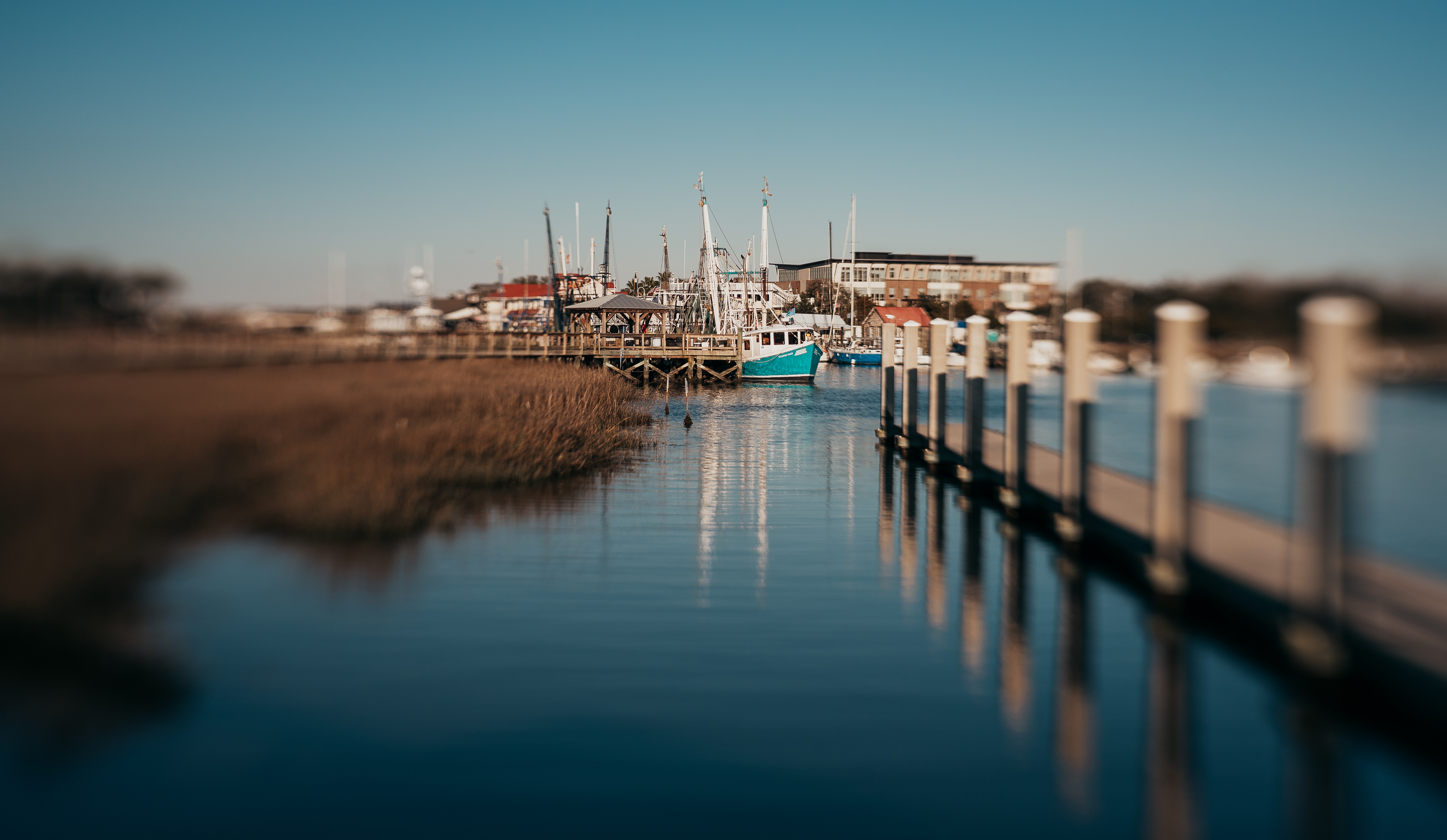
Old Village is the place where Mount Pleasant began – and for many, it remains the finest place to live in the entire Charleston metro.
Old Village at a Glance
Step beneath the canopy of live oaks draped in Spanish moss, and you feel the difference immediately. The air carries salt from Charleston Harbor. Porches face narrow streets where neighbors walk dogs and children ride bikes past homes that have stood for well over a century. Views stretch across the water toward Sullivan’s Island, and on any given night, the glow of downtown Charleston sits just across the Ravenel Bridge. This is Old Village – the historic heart of Mount Pleasant, South Carolina, and one of the most sought-after neighborhoods in America.
Old Village spans roughly 37 blocks along the harbor and Shem Creek, bordered by the creek to the north, Charleston Harbor to the east and southeast, and the broader town of Mount Pleasant to the west and south. The Old Village has a grid pattern of streets and walkways that gives it exceptional walkability – a rarity for this part of SC. Old villages often feature historic buildings and public gathering spaces, and this neighborhood delivers both in abundance.
Is Old Village in Mount Pleasant a good place to live? The answer is a clear yes. Strong public schools, direct water access, a walkable village center, and a short drive to downtown Charleston combine to create a life that balances coastal beauty with everyday convenience. Property values here have historically outperformed the broader Mount Pleasant market, making it a sound long-term investment as well.
Over his career, Bryan Crabtree of IndigoOak Christie’s International Real Estate has sold dozens of homes in Old Village and understands its micro-market at the block-by-block level. As a member of The Real Estate Experts, Bryan is the specialist buyers and sellers turn to when precision, access, and results matter most.
Why Old Village is so popular today:
- Rich history dating to the 1700s and a National Register–listed historic district
- Waterfront setting on Charleston Harbor and Shem Creek
- Tight-knit community feel with walkable streets and local shops
- Proximity to downtown Charleston (roughly 10–15 minutes) and Mount Pleasant amenities
- Limited housing supply that supports strong, lasting property values

History of Old Village & Its Harborfront Setting
Villages marked the transition from nomadic hunter-gatherers to agricultural societies roughly 10,000 years ago, and throughout human history, villages were primary loci of human belonging for multi-generational families. The story of Old Village fits this pattern perfectly – its roots are deeply agricultural, maritime, and communal.
English colonists arrived on this land in the late 17th century, drawn by harbor breezes, fertile grounds, and access to trade routes across Charleston Harbor. The early economy operated much like traditional villages worldwide: self-sufficient micro-economies centered on collective farming and trade, where villagers historically engaged in activities such as farming, baking, and crafts. These early settlements also served as small trading centers for exchanging food and livestock along the Cooper River.
Mount Pleasant was laid out by James Hibben in 1803, and the original Mount Pleasant plantation house is the Hibben House – built circa 1755 and still standing today as the oldest structure in the district. Traditional houses in Old Village often preserve distinctive construction methods and decorative arts from this era, and villages like this one preserve local materials like stone and timber to match the climate.
The modern town formed by incorporating five adjacent English villages near Shem Creek: Greenwich Village (1766), Hibben Ferry Tract (1770), Mount Pleasant Plantation (around 1808), Hilliardsville (1847), and Lucasville (1853). Villages can reflect extended-family living and communal decision-making structures, and these five communities operated exactly that way before unifying. The arrangement of homes in these villages can reveal family relationships that still echo in the street grid today. Churches and other gathering places reveal the beliefs that shaped community life in these villages throughout their evolution.
Shem Creek has been a hub for local industries for over 300 years – from colonial lime kilns and rice mills to shipbuilding, shrimping, and oystering. Villages reflect generations of adaptation to climate and geography, and the creek’s transformation from industrial waterway to a modern blend of working shrimp boats and waterfront dining is a living example. Old villages serve as records of how communities lived, worked, and worshiped, and Shem Creek’s continuous use tells that story vividly.
Among the most notable landmarks are the Pierates Cruze gardens, which opened to the public on February 20, 1943. The gardens featured thousands of prize-winning camellias and azaleas, and were awarded the Gold Medal in 1947 for hybrid camellias. The massive 1930s concrete seawall built alongside the gardens withstood Hurricane Hugo in 1989, protecting the neighborhood’s harborfront. Alhambra Hall, overlooking the harbor, remains a beloved community gathering place. The Old Village Historic District was listed on the National Register of Historic Places in 1973, and the local historic overlay was adopted in 1979 to protect the exterior character of contributing structures.
Villages can function as living history books showing how people lived. Few neighborhoods anywhere in the Southeast demonstrate that truth more powerfully than Old Village.

Living in Old Village: Lifestyle, Amenities & Daily Life
Old Village is considered one of the most desirable places to live in Mount Pleasant – and the broader Charleston area – because it offers something that newer subdivisions simply cannot replicate. The walkable village grid, mature live oak canopy, harbor views, and close-knit community vibe combine to create a daily life rooted in beauty, convenience, and authenticity. Historic villages may showcase traditional crafts passed down through generations, and Old Village carries forward a similar spirit through its artisan shops, local eateries, and hands-on waterfront culture.
The “original small town” feel is real. Narrow residential streets, front porches, neighbors who know each other by name – this is a true village center, not a suburban subdivision with a marketing name. Historical villages can preserve culinary traditions closely connected to village life, and Shem Creek’s seafood restaurants carry forward a tradition of fresh-catch dining that stretches back centuries.
Proximity to major lifestyle anchors:
- Shem Creek waterfront restaurants, boardwalk, and working shrimp boat docks are minutes away
- Mount Pleasant’s commercial corridors for shopping, dining, and daily errands
- Downtown Charleston is roughly a 10–15-minute drive across the Ravenel Bridge
- Highly rated public schools including nearby Moultrie Middle School
Nearby amenities and destinations:
- Local churches, playgrounds, pocket parks, and tennis courts
- Alhambra Hall is a popular wedding venue overlooking Charleston Harbor and hosts weddings and events throughout the year
- Waterfront park areas ideal for sunset walks and family time
- The Pitt Street Bridge – a favorite spot for walking, biking, fishing, and harbor views
The Old Village features quaint mom-and-pop shops along its shopping district: local cafés, boutiques, and the long-standing Pitt Street Pharmacy that together feel like a true neighborhood main street. Seasonal festivals in villages celebrate harvests and local traditions, and Old Village is no exception – villages often represent traditional festivals corresponding to agricultural seasons, and community events here mark the fall season, october gatherings, and holiday cheer through november and beyond. The Old World Village expands to welcome thousands from November 16 to December 28, filling the area with festive energy. The Old Time Music Celebration occurs on August 29 and 30, offering live music in a setting that feels timeless. The Old Village is open Thursday to Sunday from 10 AM to 4 PM for those who want to visit and explore.
A typical sunday might mean breakfast at a café on Pitt Street, a morning paddleboard or kayak session on Shem Creek, an afternoon walk along the harbor, and dinner at one of the waterfront eateries as the sun drops behind the bridge. On any given night, the pace is slow, the light is golden, and the air smells like salt marsh and pluff mud.

Real Estate & Market Conditions in Old Village
Old Village is among Mount Pleasant’s most established and sought-after neighborhoods. Housing inventory is inherently limited: many homes are historic and preserved, lot sizes are tight, and few large parcels remain for development. High demand paired with supply scarcity drives consistent premiums.
The housing stock is anything but cookie-cutter. You will find historic 19th-century homes, early- to mid-20th-century cottages, renovated bungalows, and newer high-end infill homes – often with custom architecture designed to respect the historic streetscape. Historic villages like this one showcase how communities operated and built over time, and the diversity of Old Village’s homes reflects that layered history.
Buyers here pay for far more than square footage. Walkability, harbor or marsh views, proximity to Shem Creek and downtown Charleston, elevation (critical for flood risk), and inclusion in the Old Village Historic District all factor into pricing. Entry-level homes are rare. Even tear-down properties can command strong prices based on lot position and view corridors. Fully renovated waterfront estates with private docks reach the top tier of Mount Pleasant pricing, while townhouses or interior cottages represent the more accessible end of the market.
Key market conditions to learn before you buy or sell:
- Low turnover – many homes are held by owners for decades
- Frequent multiple-offer situations in mid- and upper-tier properties
- A notable number of off-market and private transactions where properties sell quietly within the community
For the latest data and year-over-year trends, review the Old Village & Old Mount Pleasant (29464) – 2025 Market Trends report.
How Bryan Crabtree’s experience impacts your outcome:
- He can evaluate which streets and sub-pockets historically perform strongest across all market cycles, helping you find the right investment – not just the right house
- He helps buyers distinguish between homes with lasting value (lot, orientation, elevation, view corridors) and those that may underperform over time
- He sources opportunities before they reach public listing platforms by leveraging long-term relationships with owners, attorneys, builders, and local agents
Many of the best Old Village homes never hit the MLS. Without a specialist like Bryan, buyers risk missing properties that transact quietly within the community. Using a non-specialist agent in this market could mean the difference between securing an exceptional home and never knowing it was available.

Is Old Village a Good Place to Live? Pros, Tradeoffs & Who It Fits Best
Old Village is an excellent place to live for those seeking a historic, walkable, coastal life in Mount Pleasant – but it is not the right fit for every budget or preference. Here is an honest breakdown.
Primary advantages:
- Character-filled streets and homes instead of cookie-cutter subdivisions
- Walkability to parks, harborfront, Shem Creek restaurants, and small shops
- Strong community pride and historic preservation – you can meet your neighbors and feel rooted
- Quick access to downtown Charleston, MUSC, and the broader Mount Pleasant area
- A museum-quality setting where every block tells a story
Tradeoffs to consider:
- Higher property prices and taxes relative to newer suburbs
- Some older homes require renovation or ongoing maintenance
- Historic district guidelines can restrict certain exterior changes, materials, and rooflines
- Limited yard size or parking on some streets
- Flood insurance, hurricane wind zones, and elevation are real cost factors
Who it fits best:
- Families wanting strong schools and a safe, walkable neighborhood
- Professionals commuting to downtown Charleston or MUSC who value quality of location over square footage
- Retirees seeking charm, walkability, and community
- Second-home buyers and investors who understand that limited supply, high demand, and historic appeal have historically supported strong resale values – making Old Village one of the best places for long-term real estate investment in the region
The business case is straightforward: when inventory is this scarce and demand this persistent, values hold. That information matters whether you are buying or selling.
Working with an Old Village Specialist: Buying or Selling with Bryan Crabtree
When it comes to Old Village, general market knowledge is not enough. This is a micro-market where elevation differences of a few feet, view corridors that may or may not be preserved, and the nuances of historic district regulations all affect value. Bryan Crabtree of IndigoOak Christie’s International Real Estate has operated in this neighborhood for decades, and his track record – having personally sold dozens of Old Village properties of all types – gives him a fine-grained understanding of values street by street and block by block.
For buyers, Bryan helps you:
- Identify which homes and locations within Old Village are better long-term investments based on elevation, views, traffic patterns, and renovation potential
- Access off-market and “quiet” listings through relationships with owners, attorneys, builders, and other local agents – you will miss great opportunities if you are not connected to this network
- Navigate inspections and due diligence on older and historic homes, including flood, structural, and renovation considerations unique to Old Village
For sellers, Bryan maximizes your sale price by:
- Precision pricing grounded in recent Old Village comps and micro-market trends – not generic Mount Pleasant averages
- High-end, Christie’s-caliber marketing tailored to Old Village’s story: professional photography, video, and targeted promotion to buyers specifically seeking historic and waterfront homes
- Strategic preparation recommendations that boost perceived value without wasting money on changes Old Village buyers do not care about
Many of the best Old Village opportunities transact without ever appearing online. Buyers and sellers who do not use an Old Village expert like Bryan risk leaving money on the table or missing ideal homes entirely. There is simply no substitute for a specialist who has been inside these homes, knows these owners, and understands what drives value on every block.
If you are considering a move into or out of Old Village, Mount Pleasant, I invite you to join the conversation today. Visit The Real Estate Experts, meet Bryan Crabtree, and get free, no-obligation information on current market conditions, off-market opportunities, and a strategy built specifically for Old Village. The right time to start is now.
Leave a Reply